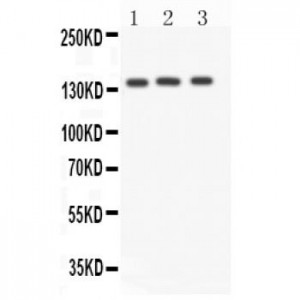
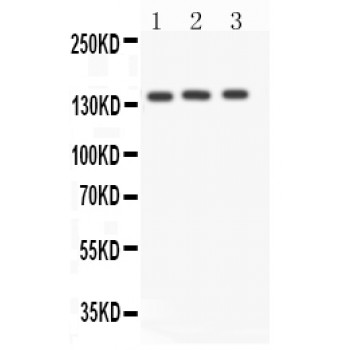
Gene | ACE |
Protein | Angiotensin-converting enzyme |
Uniprot ID | P12821 |
Function | Converts angiotensin I to angiotensin II by release of the terminal His-Leu, this results in an increase of the vasoconstrictor activity of angiotensin. Also able to inactivate bradykinin, a potent vasodilator. Has also a glycosidase activity which releases GPI-anchored proteins from the membrane by cleaving the mannose linkage in the GPI moiety. |
Tissue Specificity | Ubiquitously expressed, with highest levels in lung, kidney, heart, gastrointestinal system and prostate. Isoform Testis-specific is expressed in spermatocytes and adult testis. |
Sub-cellular localization | Angiotensin-converting enzyme, soluble form: Secreted. |
Sequence Similarities | Belongs to the peptidase M2 family. |
Aliases | ACE 1 antibody|ACE antibody|ACE T antibody|ACE_HUMAN antibody|ACE1 antibody|Angiotensin converting enzyme somatic isoform antibody|Angiotensin converting enzyme testis specific isoform antibody|Angiotensin I converting enzyme 1 antibody|Angiotensin I converting enzyme antibody|Angiotensin I converting enzyme peptidyl dipeptidase A 1 antibody|Angiotensin-converting enzyme antibody|Carboxycathepsin antibody|CD 143 antibody|CD143 antibody|CD143 antigen antibody|DCP 1 antibody|DCP antibody|DCP1 antibody|Dipeptidyl carboxypeptidase 1 antibody|Dipeptidyl carboxypeptidase I antibody|Kininase II antibody|MGC26566 antibody|MVCD3 antibody|Peptidase P antibody|Peptidyl dipeptidase A antibody|soluble form antibody|Testicular ECA antibody |