
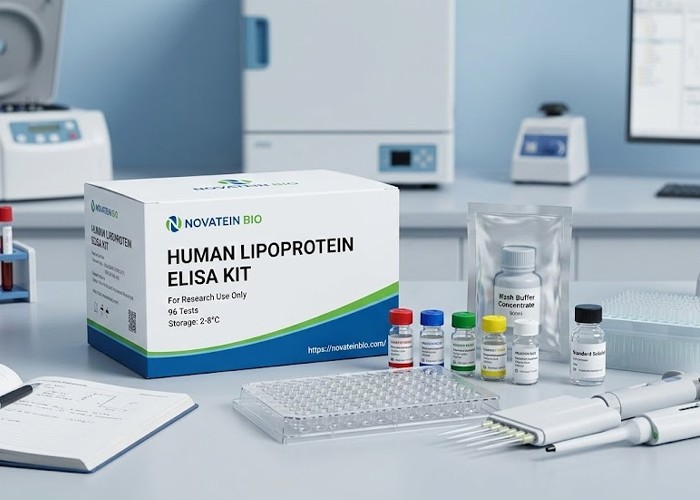
Quantifying human lipoproteins in serum using ELISA technology allows you to measure specific fat-carrying proteins with incredible precision. You need this data to get a clear picture of cardiovascular health or to monitor how a patient responds to a new metabolic treatment. Unlike basic lipid panels that only give you a broad look at cholesterol, an Enzyme-Linked Immunosorbent Assay (ELISA) targets the individual protein components that move those lipids through the blood. Using a high-quality Human Lipoprotein ELISA kit makes this process straightforward and reliable for any laboratory setting.
We at Novatein Biosciences recognize that your research or clinical data depends entirely on the accuracy of your reagents. Our team focuses on providing tools that take the guesswork out of complex serum analysis. Lipoproteins like LDL, HDL, and VLDL are more than just numbers on a lab report; they are complex particles that require specific antibodies for proper identification. We supply the kits and components necessary to ensure your results are reproducible every single time you run an assay.
Why is ELISA the Preferred Method for Lipoprotein Analysis?
Standard chemical assays often struggle to distinguish between different subclasses of lipoproteins because their structures are so similar. ELISA technology uses the unique lock-and-key fit of antibodies to find exactly what you are looking for in a crowded serum sample. You get a level of sensitivity that other methods simply cannot match. This becomes vital when you are measuring low-density particles that might be masked by more abundant proteins. Researchers prefer this method because it provides a quantitative value rather than just a qualitative "yes or no" answer.
Consistency is the biggest hurdle in any long-term study. ELISA plates come pre-coated, which reduces the manual labor and the potential for human error during the coating phase. You can process dozens of samples at once, making it an efficient choice for large-scale screenings. The color change you see at the end of the test gives a visual confirmation before you even put the plate into the reader. It is a practical, tried-and-true approach that has remained a gold standard for a reason.
How Do You Prepare Serum Samples Correctly?
Getting the sample right is the most important part of the entire procedure. You must collect blood in a way that prevents hemolysis, as ruptured red cells can interfere with the antibody binding. Once you have the serum, keeping it on ice or freezing it at the correct temperature preserves the integrity of the lipoprotein particles. Lipoproteins are sensitive to temperature shifts and can degrade or aggregate if handled roughly. Taking these small precautions at the start prevents many headaches when you are analyzing your final data.
Buffer choice also plays a huge role in how well your assay performs. Some specialized protocols require Dextrose Gelatin Veronal DGV to maintain the right ionic strength and stability during the incubation periods. This specific buffer helps in keeping the proteins in their natural shape so the antibodies can recognize them easily. Using the correct reagents during the wash and dilution steps ensures that you aren't washing away your target proteins along with the waste.
What Are the Benefits of Using a Human Lipoprotein ELISA Kit?
- High Sensitivity: You can detect even minute concentrations of lipoproteins that might be missed by traditional colorimetric tests.
- Specific Targeting: The antibodies in the kit are designed to ignore other serum proteins, focusing only on the lipoprotein of interest.
- Speed: Most kits allow you to go from a raw serum sample to a full data set in just a few hours.
- Small Sample Volume: You only need a tiny amount of serum, which is perfect when you are working with limited clinical samples.
How Does Dextrose Gelatin Veronal DGV Improve Assay Stability?
Maintaining the right environment for your proteins is a science in itself. Some assays involve the complement system or require very specific ion concentrations to keep the lipoproteins from clumping together. Dextrose Gelatin Veronal DGV acts as a stabilizing agent that protects the proteins during these sensitive stages. The gelatin provides a protective coating that prevents the proteins from sticking to the plastic walls of the tubes or plates.
Stabilizing your samples means your results will be the same whether you run the test today or next week. Dextrose provides a bit of osmotic balance, while the veronal acts as a steady buffer. We see much better curve linearity when researchers use the appropriate stabilizing buffers. It is one of those small details that separates a mediocre lab result from a professional, publishable data set.
Why Should You Trust Our Lipoprotein Detection Tools?
Experience in the biotech industry has taught us that quality control is everything. We at Novatein Biosciences test our kits against rigorous standards to ensure they meet the needs of modern researchers. Our team understands that a failed assay is a waste of both time and expensive samples. We provide clear instructions and technical support to help you get the most out of every well on your plate.
Reliability is the core of our brand. When you order from us, you are getting reagents that have been validated for performance and shelf-life. We make it easy to buy these tools online so you can get back to your research without delay. Your success in the lab is the primary goal of our product development.
Frequently Asked Questions
How long does a typical lipoprotein ELISA take to complete?
Most of our kits require about three to four hours from start to finish. This includes the initial incubation of the serum, the washing steps, the addition of the conjugate, and the final color development. It is a very efficient way to get high-quality data in a single afternoon.
Can I use plasma instead of serum for these assays?
Yes, you can often use plasma, but you must be careful about the anticoagulant used. Heparin can sometimes interfere with certain lipoprotein measurements. We usually recommend serum for the cleanest results, but check the specific kit manual for instructions on using EDTA or citrate plasma.
What is the shelf life of a Human Lipoprotein ELISA Kit?
Typically, our kits remain stable for six to twelve months when stored at the recommended $4°C$. Always keep the components in their original packaging and avoid freezing the pre-coated plates. The chemical substrates are light-sensitive, so keep them in the dark until you are ready to use them.
Reach Out for Expert Technical Support
Ready to take your metabolic research to the next level? You can find our full range of detection tools on our website. We offer various kits designed for specific apolipoproteins and lipid markers to suit your project needs. If you have questions about sample preparation or which buffer is right for your experiment, our technical team is ready to help. Browse our catalog and secure the reagents you need for your next big discovery.