
- New
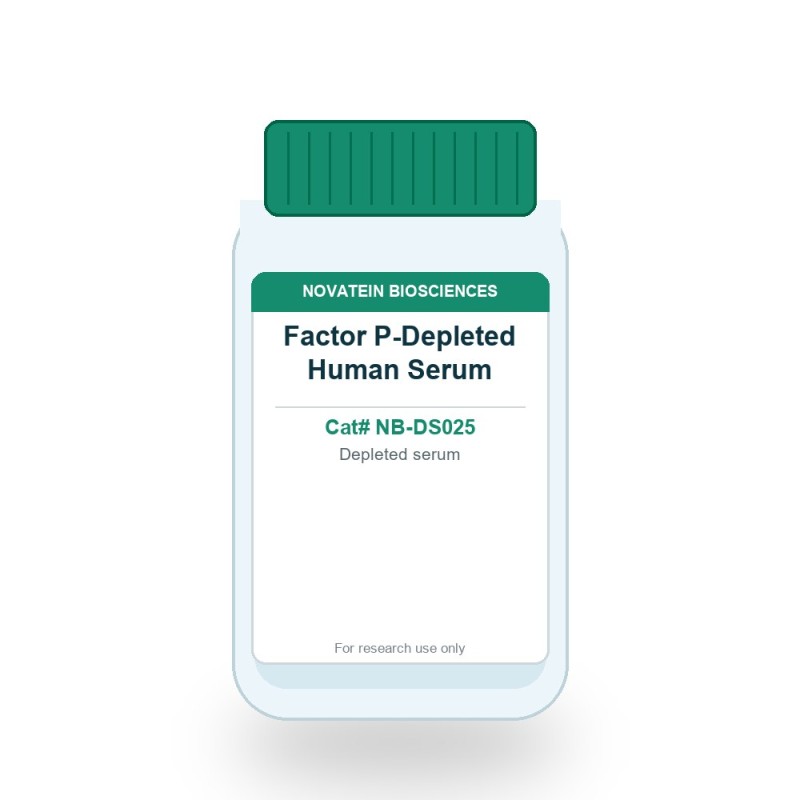

Catalog # NB-DS025
Factor P-Depleted Human Serum (catalog number NB-DS025) is a complement research reagent from Novatein Biosciences. Size: 1.0 ml/vial.
Handling: human-derived material. Use normal precautions for handling human blood products.
Normal human serum was depleted of factor P (properdin) by immunoaffinity chromatography. The product is tested for the absence of factor P by double immunodiffusion. Factor P is a positive regulator of alternative pathway complement activation. As a result, Factor P-Dpl is still capable of activating the alternative pathway but activation is slower than with properdin present. For example, lysis of rabbit erythrocytes by Factor P-Dpl requires 20-25 min to reach 50% without properdin, but with P added back or in NHS lysis requires only 5-7 min under otherwise identical conditions. Factor P-Dpl is certified to possess a functional alternative pathway for complement activation which is fully functional if reconstituted with properdin. Full reconstitution requires addition of 10 µg factor P/mL serum. The normal human serum concentration of factor P has been variously reported to be between 4 and 20 µg/mL.
Factor P-Dpl is supplied as a clear, straw-colored liquid containing all proteins of normal human serum except complement factor P (properdin) and C1q.
Factor P-Dpl serum is not completely functionally deficient in alternative pathway activity, but without factor P the feedback loop of the alternative pathway does not activate or amplify as rapidly as with properdin present. The depleted serum is reconstituted with 10 µg/mL factor P and tested to verify that a fully functional alternative pathway is restored. It is tested for alternative pathway function using rabbit erythrocytes. The Certificate of Analysis provided with each lot gives a description of the assays and specific titers for the depleted and reconstituted sera compared to normal human serum. Because the only difference in alternative pathway activity between Factor P-Dpl, reconstituted P-Dpl and NHS is the time to activation, a graph of the time course of each of these assays is provided with the Certificate of Analysis.
Two assays are used to analyze Factor P-Dpl. The first determines the time required for 50% lysis of rabbit erythrocytes in 20% serum containing 5 mM MgEGTA. Three samples are compared: NHS, Factor P-Dpl and Factor P-Dpl reconstituted with 10 ug/mL purified factor P. From these assays one can determine the time at which there is the maximum difference between the P- depleted and the reconstituted serum. This time is the best time of incubation to use to titer properdin activity in unknown samples. The second assay measures the APH50 of reconstituted Factor P-Dpl and compares this to the APH50 of NHS. The later assays measure how effective the reconstituted serum is in a functional alternative pathway assay by measuring the amount of serum needed to lyse 50% of 1.25 x 10⁷ rabbit erythrocytes) when incubated in GVBo containing a final concentration of 5 mM MgEGTA in a total volume of 100 µL for 10 min at 37oC. Various MgEGTA concentrations, from 3 mM to 13 mM, have been reported to be effective in alternative pathway assays. See the Certificate of Analysis for lot specific titer values. Factor P-Dpl serum possesses a fully functional classical pathway. It is tested for classical pathway activity with assays using antibody-sensitized sheep erythrocytes. The Certificate of Analysis provided with each lot gives a description of the assay and specific titer for the reconstituted depleted serum and compared to normal human serum. Lectin pathway activity is not routinely tested or certified, but it would be expected to be active.
Factor P-Dpl can be used to assay the functional activity of factor P (properdin) and to examine the behavior of the alternative pathway amplification system with and without factor P.
The source is human serum, therefore precautions appropriate for handling any blood-derived product must be used even though the source was shown by certified tests to be negative for HBsAg and for antibodies to HCV, HIV-1 and HIV-II.
Hazard Code: B MSDS is available upon request.