
- New
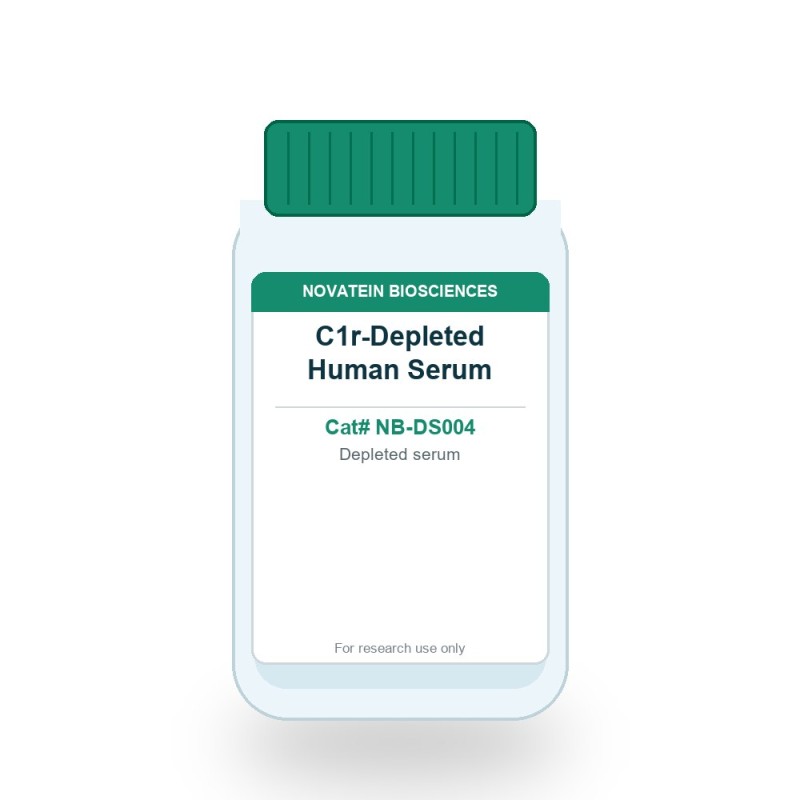

Catalog # NB-DS004
C1r-Depleted Human Serum (catalog number NB-DS004) is a complement research reagent from Novatein Biosciences. Size: 0.5 ml/vial.
Handling: human-derived material. Use normal precautions for handling human blood products.
C1r depleted serum (C1r-Dpl) is normal human serum depleted of C1r by immunoaffinity chromatography. The product is tested for the absence of C1r by functional assays for classical pathway activity and for C1r protein by double immunodiffusion. C1r-Dpl is certified to possess a functional alternative pathway for complement activation. In serum C1r is present in its proenzyme form. C1r enzyme is the activated form of C1r proenzyme. C1r is a subunit of the C1 complex which is the first component in the classical pathway of complement. C1r proenzyme is an inactive zymogen until C1 is activated. C1r is activated when C1 binds to and is activated by antibodies bound to antigens (immune complexes) yielding C1r enzyme, the first protease that initiates the cascade. A functional classical pathway can be reconstituted by addition of purified C1r enzyme or proenzyme (34 µg/mL) to the C1r-Dpl indicating that all other complement components necessary for classical pathway activation are present and active.
Activated C1r is rapidly inactivated by C1-INH. The spontaneous activation of C1r observed with pure C1 and pure C1r proenzyme is minimized by the presence of C1- INH which rapidly inactivates spontaneously activated C1r enzyme. Stabilization of the proenzyme is also due to the existence of a weak complex between C1-INH and C1r proenzyme. This association apparently stabilizes C1 thus preventing spontaneous activation in serum. Separation of C1- INH from C1 during purification is one of the reasons that isolated C1 and C1r proenzyme are unstable and prone to spontaneous activation.
C1r-Dpl is supplied as a clear, straw-colored liquid containing all proteins of normal human serum except complement component C1r.
The depleted serum is tested for remaining classical pathway activity (CH50 assay) by hemolytic assays using antibody-sensitized sheep erythrocytes and for alternative pathway function (AP50 assay) using rabbit erythrocytes. The depleted serum is reconstituted with 34 µg/mL C1r enzyme and retested to verify that a functional classical pathway is restored. The Certificate of Analysis provided with each lot gives a description of the assays and specific titers for the depleted and reconstituted sera compared to normal human serum.
The unit of classical pathway activity is the CH50. The classical pathway activity is reported as the standard CH50 value for C1r-Dpl + C1r enzyme added equivalent to 34 ug C1r/mL in the undiluted serum. The CH50 activity is determined as the amount of reconstituted serum needed to lyse 50% of 1 x 10⁸ EA cells (antibody-sensitized sheep erythrocytes) when incubated for 60 min at 37 oC in a total volume of 1.5mL GVB++. When purified C1r enzyme is added to C1r-Dpl, most of it complexes with the C1-INH present in the depleted serum. However, the remaining free C1r enzyme, that is not complexed to C1-INH, is sufficient to give a fully functional classical pathway (CH50) with activity comparable to normal human serum used as standard. See the Certificate of Analysis for lot specific titer values. The CH50 activity can also be determined by reconstituting the C1r-Dpl with purified C1r proenzyme equivalent to 34 ug C1r/mL in the undiluted serum. A similar unit, the C1rH50 is used to quantitate the activity of C1r and C1r-Dpl. The C1rH50 assay cannot be used to quantitate the functional activity of C1r enzyme because C1-INH present in the depleted serum interacts with the enzymatic form of C1r and rapidly inactivates it. The C1rH50 assay requires the proenzyme form of C1r. Alternative pathway titers are performed to document that this pathway of complement activation is fully functional in C1r-Dpl. Lectin pathway activity is not tested.
C1r-Dpl is used to assay C1r hemolytic activity in samples and to supply an alternative pathway activating system that is incapable of activating the classical pathway of complement.
The source is human serum, therefore precautions appropriate for handling any blood-derived product must be used even though the source was shown by certified tests to be negative for HBsAg and for antibodies to HCV, HIV-1 and HIV-II.
Hazard Code: B MSDS available upon request.