
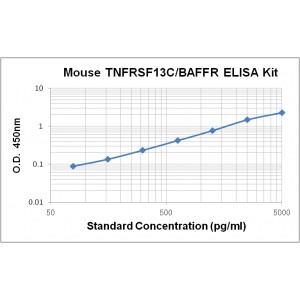

Catalog # FM-E100174
Assay Range | 78 - 5,000 pg/mL |
Sensitivity | 10.0 pg/mL |
Size | 96T |
Storage | Store at 2 - 8ºC. Keep reconstituted standard and detection Ab at -20 ºC |
Assay Principle | Sandwich ELISA |
Sample Volume | 100 µL final volume, dilution factor varies on samples |
Detection Method | Chromogenic |
Kit Components
1. Recombinant Mouse TNFRSF13C standard: 2 vials
2. One 96-well plate coated with Mouse TNFRSF13C Ab
3. Sample diluent buffer: 12 mL - 1
4. Detection antibody: 130 µL, dilution 1:100
5. Streptavidin-HRP: 130 µL, dilution 1:100
6. Antibody diluent buffer: 12 mL x1
7. Streptavidin-HRP diluent buffer: 12 mL x1
8. TMB developing agent: 10 mL x1
9. Stop solution: 10 mL x1
10. Washing solution (20x): 25 mL x1
Background
Tumor necrosis factor receptor superfamily member 13C (TNFRSF13C), also known as B-cell-activating factor receptor (BAFF receptor, BAFF-R), BLyS receptor 3, or CD268, is a member of the tumor necrosis factor receptor superfamily. The TNFRSF13C extracellular domain lacks the TNF receptor canonical cysteine-rich domain (CRD) and contains only a partial CRD with four cysteine residues. Human and mouse TNFRSF13C share 56% aa sequence identity. TNFRSF13C is highly expressed in spleen, lymph node and resting B cells. It is also expressed at lower levels in activated B cells, in resting CD4+ T cells, in thymus and peripheral blood leukocytes. TNFRSF13C selectively binds BAFF to regulate the downstream signaling pathways. BAFF (B cell activating factor), also known as TNFSF13B, BlyS, TALL1, TNAK, and zTNF4, is a TNF superfamily member produced by macrophages, dendritic cells, and T lymphocytes. BAFF promotes the survival of B cells and is essential for B cell maturation. In addition to binding to TNFRSF13C, BAFF also binds to two other TNF receptor superfamily members: B-cell maturation antigen (BCMA/TNFRSF17), transmembrane activator and calciummodulator and cyclophilin ligand interactor (TACI/TNFRSF13B). It is reported that BAFF knockout mice lack mature B cells. Interestingly, A/WySnJ mice that are defective in TNFRSF13C intracellular signaling also lack mature B cells, BCMA or TACI deficient mice, however, have no major defect in B cell development, suggesting that TNFRSF13C is the critical receptor for BAFF during B lymphopoiesis.