
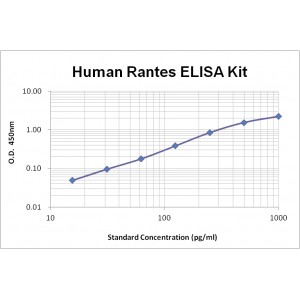

Catalog # FM-E100119
Assay Range | 15.6-1,000 pg/mL |
Sensitivity | 3.0 pg/mL |
Size | 96T |
Storage | Store at 2 - 8ºC. Keep reconstituted standard and detection Ab at -20 ºC |
Assay Principle | Sandwich ELISA |
Sample Volume | 100 µL final volume, dilution factor varies on samples |
Detection Method | Chromogenic |
Kit Components
1. Recombinant Human CCL5 standard: 2 vials
2. One 96-well plate coated with anti- Human CCL5 Ab
3. Sample diluent buffer: 12 mL - 1
4. Detection antibody: 130 µL, dilution 1:100
5. Streptavidin-HRP: 130 µL, dilution 1:100
6. Antibody diluent buffer: 12 mL x1
7. Streptavidin-HRP diluent buffer: 12 mL x1
8. TMB developing agent: 10 mL x1
9. Stop solution: 10 mL x1
10. Washing solution (20x): 25 mL x1
Background
C-C motif chemokine 5 (CCL5), also known as RANTES (Regulated upon Activation, Normal T cell Expressed and presumably Secreted), EoCP, Eosinophil chemotactic cytokine, SIS-delta, Small-inducible cytokine A5, T cell-specific protein P228 (TCP228), is a member of the CC chemokine family. Human CCL5 is synthesized as a 91 amino acid (aa) precursor protein containing a 23 aa hydrophobic signal peptide and a 68 aa mature protein. Human CCL5 exhibits approximately 85% aa sequence identity with mouse CCL5.
CCL5 interacts with four G-protein coupled receptors: CCR1, CCR3, CCR4, and CCR5. CCL5 binding can activate a variety of context -dependent signaling cascades. For example, in T-cells, CCL5 causes elevations of intracellular Ca2+ and activation of focal adhesion kinase (FAK), protein kinase A, PI3-kinase, Rho GTPase, and JAK/STAT signaling pathways. The CCL5 receptor CCR5 also is the primary co-receptor for R5 variants of HIV-1. CCL5 and other CCR5 ligands, macrophage inflammatory protein (MIP)-1α and MIP-1β, can competitively inhibit CCR5/HIV-1 interaction and suppress viral infection in vitro. CCL5 has showed potent chemotactic activity for many different cell types including unstimulated CD4+/CD45RO+ memory T cells and stimulated CD4+ and CD8+ T cells with naive and memory phenotypes, NK cells, basophils, eosinophils, dendritic cells, mast cells, monocytes, and microglia. In addition, CCL5 can activate T cells, monocytes, neutrophils, NK cells, dendritic cells, and astrocytes. CCL5 knockout mice are unable to recruit leukocytes to sites of acute inflammation.