
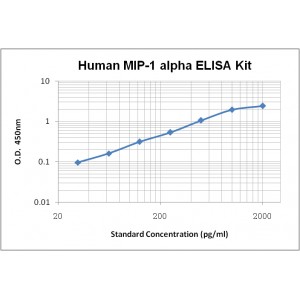

Catalog # FM-E100091
Assay Range | 31.2 - 2,000 pg/mL |
Sensitivity | 10.0 pg/mL |
Specificity | No cross-reaction with other related substances detected |
Size | 96T |
Storage | Store at 2 - 8ºC. Keep reconstituted standard and detection Ab at -20 ºC |
Assay Principle | Sandwich ELISA |
Sample Volume | 100 µL final volume, dilution factor varies on samples |
Detection Method | Chromogenic |
Kit Components
1. Recombinant Human MIP-1 alpha standard: 2 vials
2. One 96-well plate coated with Human MIP-1 alpha Ab
3. Sample diluent buffer: 12 ml— 2
4. Detection antibody: 130 µL, dilution 1:100
5. Streptavidin-HRP: 130 µL, dilution 1:100
6. Antibody diluent buffer: 12 mL x1
7. Streptavidin-HRP diluent buffer: 12 mL x1
8. TMB developing agent: 10 mL x1
9. Stop solution: 10 mL x1
10. Washing solution (20x): 25 mL x1
Background
Macrophage Inflammatory Protein-1 alpha (MIP-1α), also known as CCL3, G0/G1 switch regulatory protein 19-1, PAT 464.1, SIS-beta, small-inducible cytokine A3, Tonsillar lymphocyte LD78 alpha protein, is a member of the CC family. Human MIP-1α is synthesized as a 92 amino acid (aa) precursor protein consisting of a 22 aa residue signal peptide and a 70aa secreted mature protein. MIP-1α is expressed on various cell types such as activated T cells, B cells, monocytes, mast cells, neutrophils, Langerhans cells, astrocytes, endothelial cells, fibroblasts and smooth muscle cells.
MIP-1α is a ligand for CCR1, CCR4 and CCR5. Primarily, MIP-1α plays a chemotractic role in diverse immune cells including monocyte, T-lymphocytes, NK cells, cytotoxic T cells, B cells, basophils, and eosinophils. In addition, MIP-1α can function as a stem cell inhibitor (SCI) to inhibit the proliferation of hematopoietic progenitor cells both in vitro and in vivo.