
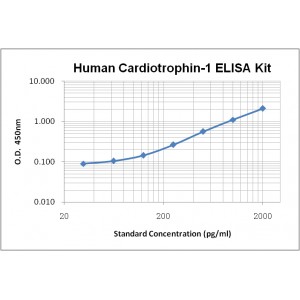

Catalog # FM-E100316
Assay Range | 31.2-2,000 pg/mL |
Sensitivity | 10.0 pg/mL |
Specificity | No cross-reaction with other related substances detected |
Size | 96T |
Storage | Store at 2 - 8ºC. Keep reconstituted standard and detection Ab at -20 ºC |
Assay Principle | Sandwich ELISA |
Sample Volume | 100 µL final volume, dilution factor varies on samples |
Detection Method | Chromogenic |
Kit Components
1. Recombinant Human Cardiotrophin-1 standard: 2 vials
2. One 96-well plate coated with Human Cardiotrophin-1 Ab
3. Sample diluent buffer: 12 mL - 1
4. Detection antibody: 130 µL, dilution 1:100
5. Streptavidin-HRP: 130 µL, dilution 1:100
6. Antibody diluent buffer: 12 mL x1
7. Streptavidin-HRP diluent buffer: 12 mL x1
8. TMB developing agent: 10 mL x1
9. Stop solution: 10 mL x1
10. Washing solution (20x): 25 mL x1
Background
Cardiotrophin1 (CT-1) is a member of the IL-6 family and is widely expressed in the heart, skeletal muscle, prostate, ovary, lung, kidney, pancreas, thymus, testis and small intestine with a higher level at heart and skeletal muscle. CT-1 is a cardiac hypertrophic factor with overlapping functions with other members of IL-6 family. Human and mouse CT-1 share 80% aa sequence identity and exhibit species cross-reactivity. CT-1 initiates its downstream signaling pathways by interacting with the glycoprotein 130 (gp130)/leukemia inhibitory factor receptor beta (LIFR) heterodimer. Activations of phosphatidylinositol 3-kinase (PI-3 kinase) and transcription factor NF-κB are involved in CT-1 mediated cellular processes. CT-1 has been implicated in the pathophysiology of certain heart diseases, including hypertension, myocardial infarction, valvular heart disease, and congestive heart failure.