
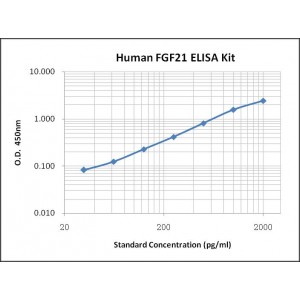

Catalog # FM-E101116
Assay Range | 31.2-2,000 pg/mL |
Sensitivity | 10.0 pg/mL |
Specificity | No cross-reaction with other related substances detected |
Size | 96T |
Storage | Store at 2 - 8ºC. Keep reconstituted standard and detection Ab at -20 ºC |
Assay Principle | Sandwich ELISA |
Sample Volume | 100 µL final volume, dilution factor varies on samples |
Detection Method | Chromogenic |
Kit Components
1. Recombinant Human FGF21 standard: 2 vials
2. One 96-well plate coated with Human FGF21 Ab
3. Sample diluent buffer: 12 mL - 1
4. Detection antibody: 130 µL, dilution 1:100
5. Streptavidin-HRP: 130 µL, dilution 1:100
6. Antibody diluent buffer: 12 mL x1
7. Streptavidin-HRP diluent buffer: 12 mL x1
8. TMB developing agent: 10 mL x1
9. Stop solution: 10 mL x1
10. Washing solution (20x): 25 mL x1
Background
Fibroblast growth factor 21 (FGF-21) is a member of the FGF gene family which is characterized by 120 amino acid (aa) core FGF domain that displays a β-trefoil structure. FGF-21 is a member of the FGF-19 subfamily which also includes FGF-19 and FGF-23. Unlike other FGFs, FGF-19 members lack one strand of the β-trefoil and bind poorly to extracellular matrix molecules such as heparin. They are consequently more diffusible than other FGFs. FGF-21 binds FGF receptors (FGF R) indirectly through co-receptors of the klotho family, while it directly binds to β-Klotho via its C-terminal sequence, which is required for signaling through FGF R. FGF-21 is produced by hepatocytes in response to free fatty acid (FFA) mediated PPARα-RXR activation. This situation occurs during starvation, diabetic ketosis, or following the ingestion of a high-fat/low-carbohydrate or ketogenic diet. Upon FGF-21 secretion, white adipose tissue is induced to release FFAs from triglyceride stores. FGF-21 production is also induced upon differentiation of human or mouse fibroblasts to adipocytes. In adipose tissue, FGF-21 induces glucose uptake in synergy with PPARγ to increase production of the glucose transporter, GLUT1. It is reported that, in diet-induced obese mice and mouse models of diabetes, administration or transgenic overexpression of FGF-21 restores circulating glucose and triglyceride values to near normal and increases insulin sensitivity.